

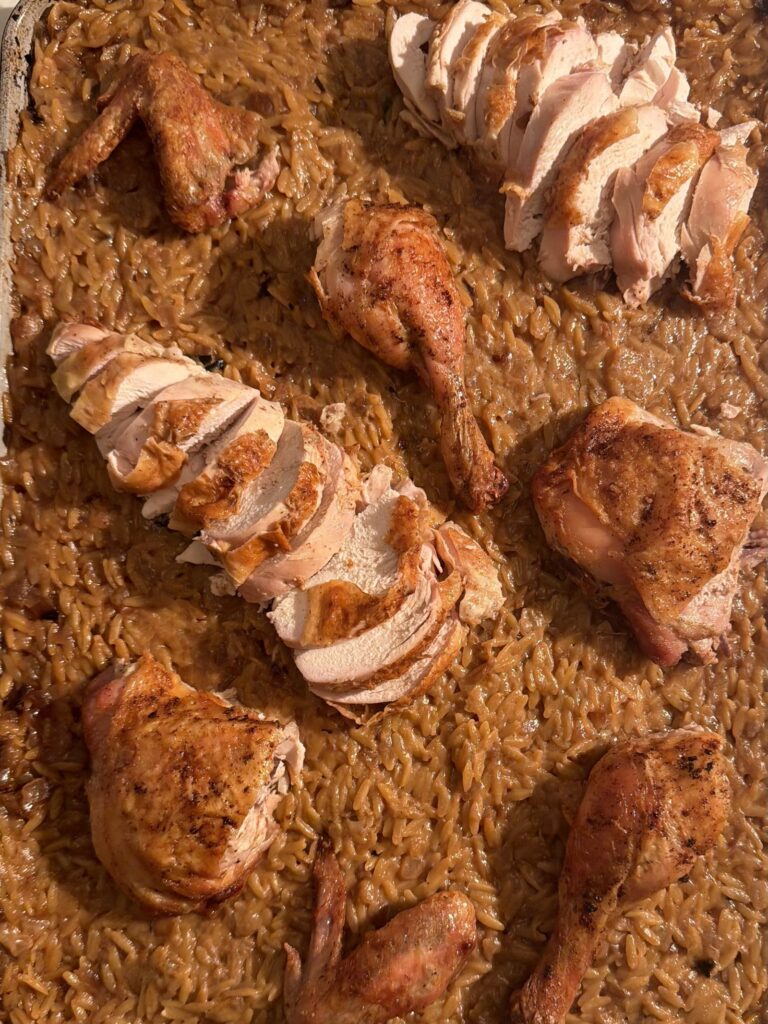

This sheet pan French onion roast chicken with creamy Gruyère orzo is cozy, impressive, and way easier than it looks. A whole spatchcock chicken roasts on a rack over a bed of onions and fresh thyme, so all of those flavorful drippings fall right onto the onions. Then the onions become the base for creamy French onion orzo made with beef broth, white wine, Dijon, Worcestershire, heavy cream, and freshly grated Gruyère. It’s a full roast chicken dinner made on one pan, and it’s a great recipe if you’re still learning how to cook.
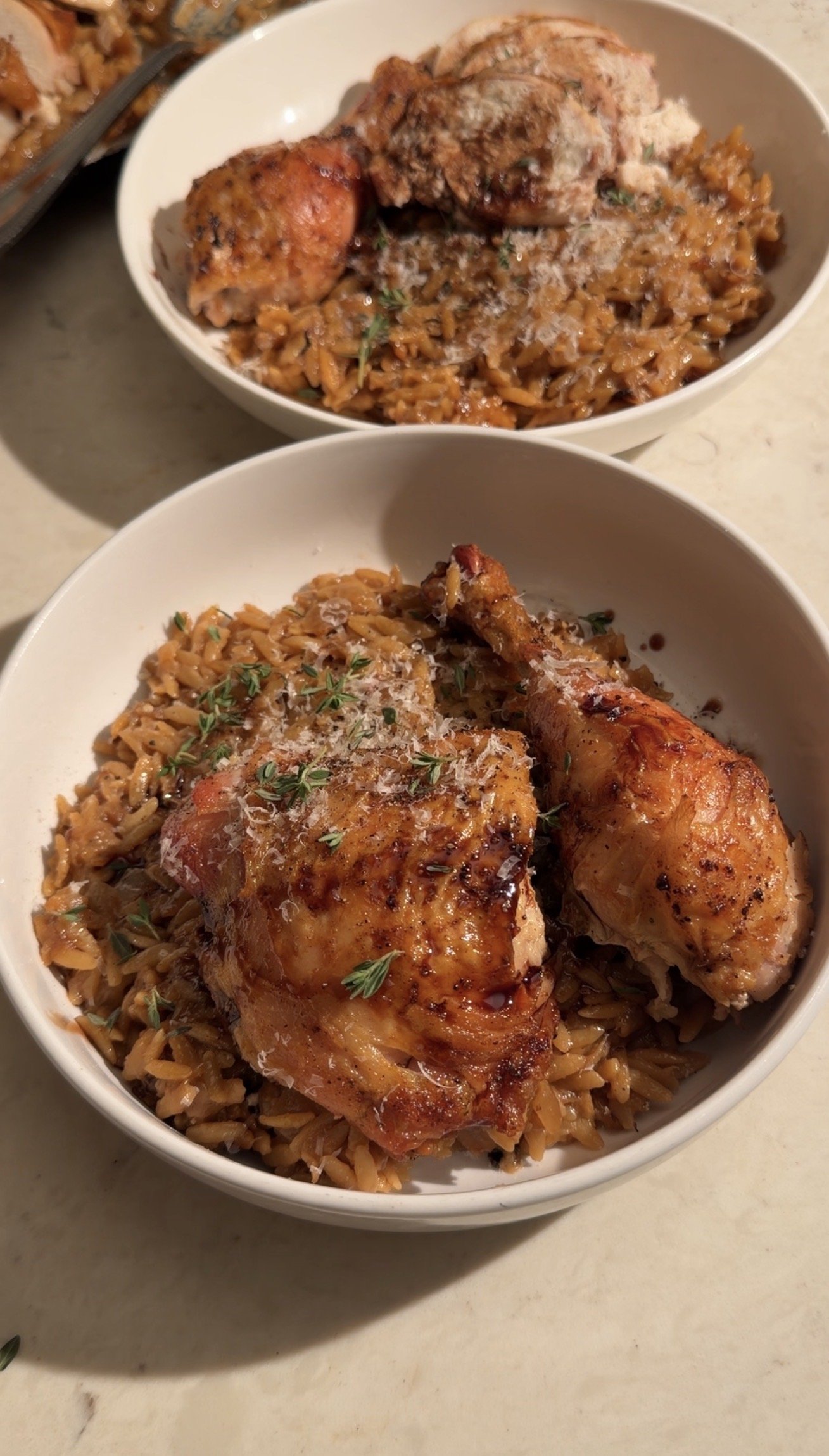
Why you’ll love this French onion chicken and orzo
- One sheet pan: the chicken, onions, and orzo all cook on the same pan, so there’s less to wash.
- All the French onion soup flavor: caramelized onions, beef broth, white wine, thyme, and melty Gruyère.
- Crispy skin, juicy chicken: spatchcocking helps the chicken cook faster and more evenly.
- Beginner friendly: every step is explained, including what spatchcock and deglaze mean.
What you need for sheet pan French onion chicken
- Whole chicken (4–4½ lb): ask your butcher to spatchcock it for you to save time.
- Yellow onions: about 6 cups diced. They roast in the chicken drippings and become the base for the orzo.
- Diamond Crystal kosher salt: if you use Morton, use about half as much.
- Dry white wine: something like Sauvignon Blanc or Pinot Grigio for deglazing. No wine? See the swap in the recipe notes.
- Orzo: any brand of dry orzo works. You’ll use a full 16-ounce bag.
- Beef broth, Dijon, and Worcestershire: these give the orzo that rich French onion soup flavor.
- Heavy cream and Gruyère: grate the Gruyère from a block so it melts smoothly.
- Water: keep 2–4 cups next to the oven to add to the onions as they roast.
The full ingredient list with measurements is in the recipe card below.
Equipment
You’ll need a large half sheet pan (18 × 13 inches) with at least a 1-inch rim, an oven-safe wire rack that fits inside it, kitchen shears, aluminum foil, and an instant-read meat thermometer. The thermometer is the one tool you really need, because it’s the only reliable way to know your chicken is done.
How to make sheet pan French onion roast chicken and orzo
1. Spatchcock and season the chicken
Spatchcocking just means cutting out the backbone so the chicken lies flat. Season it generously with salt, pepper, and your favorite garlic-and-herb blend, including under the skin.
2. Roast the chicken over the onions
Toss the onions with oil, salt, and ⅓ cup water, set a rack over them, and roast the chicken on top at 425°F. Starting with a little water helps the onions soften before they brown.
3. Add splashes of water as needed
After 30 minutes, check the edges of the pan. If the onions are getting dark, add a splash of water (about ¼–½ cup) and keep checking every 10–15 minutes. Add a little at a time so the water evaporates and the onions caramelize instead of boiling.
4. Bake the orzo right in the pan
While the chicken rests, deglaze the onions with white wine, stir in the orzo, beef broth, Dijon, Worcestershire, and cream, then cover tightly with foil and bake at 400°F until the orzo is tender and creamy.
5. Stir in the Gruyère and serve
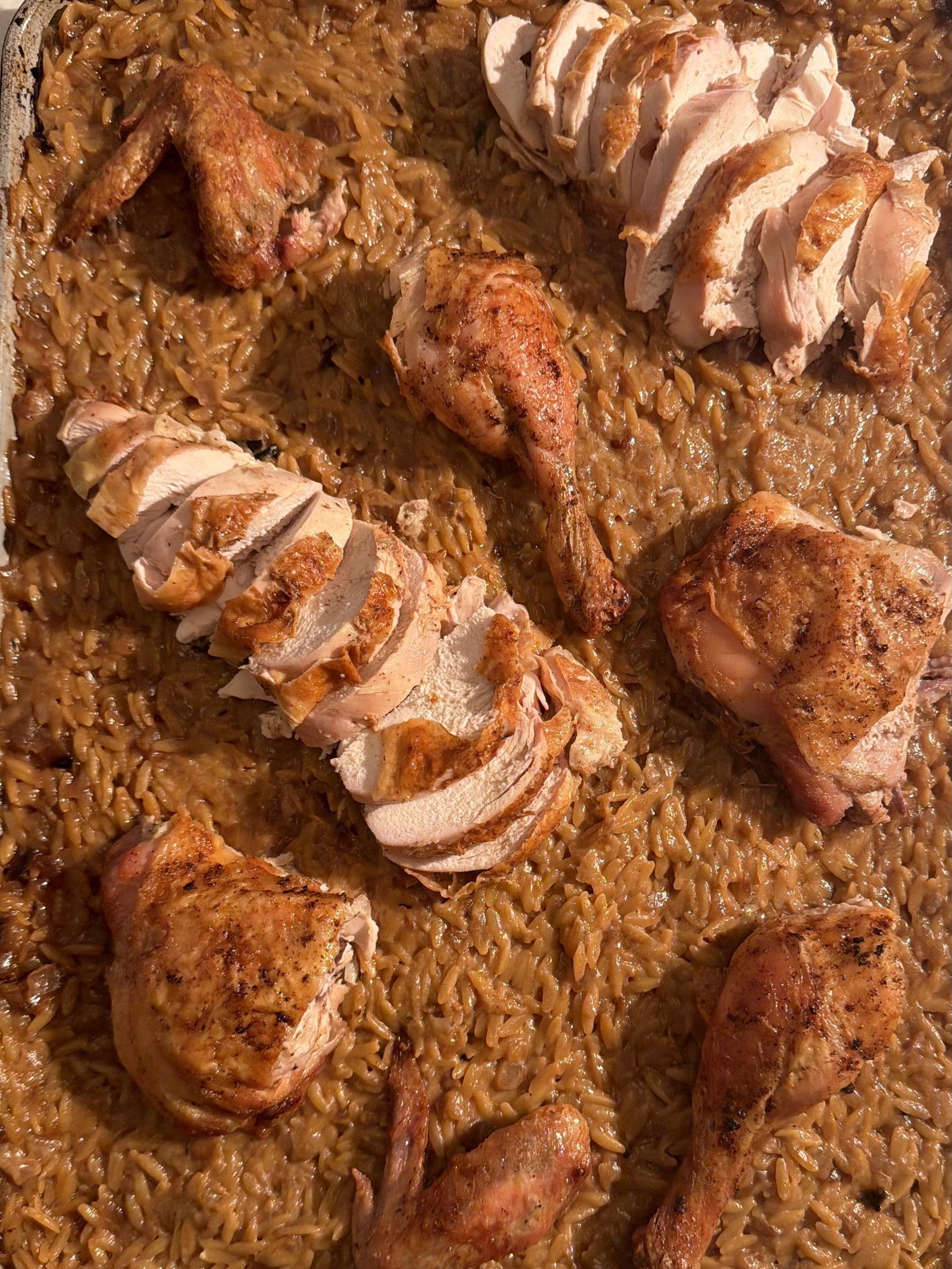
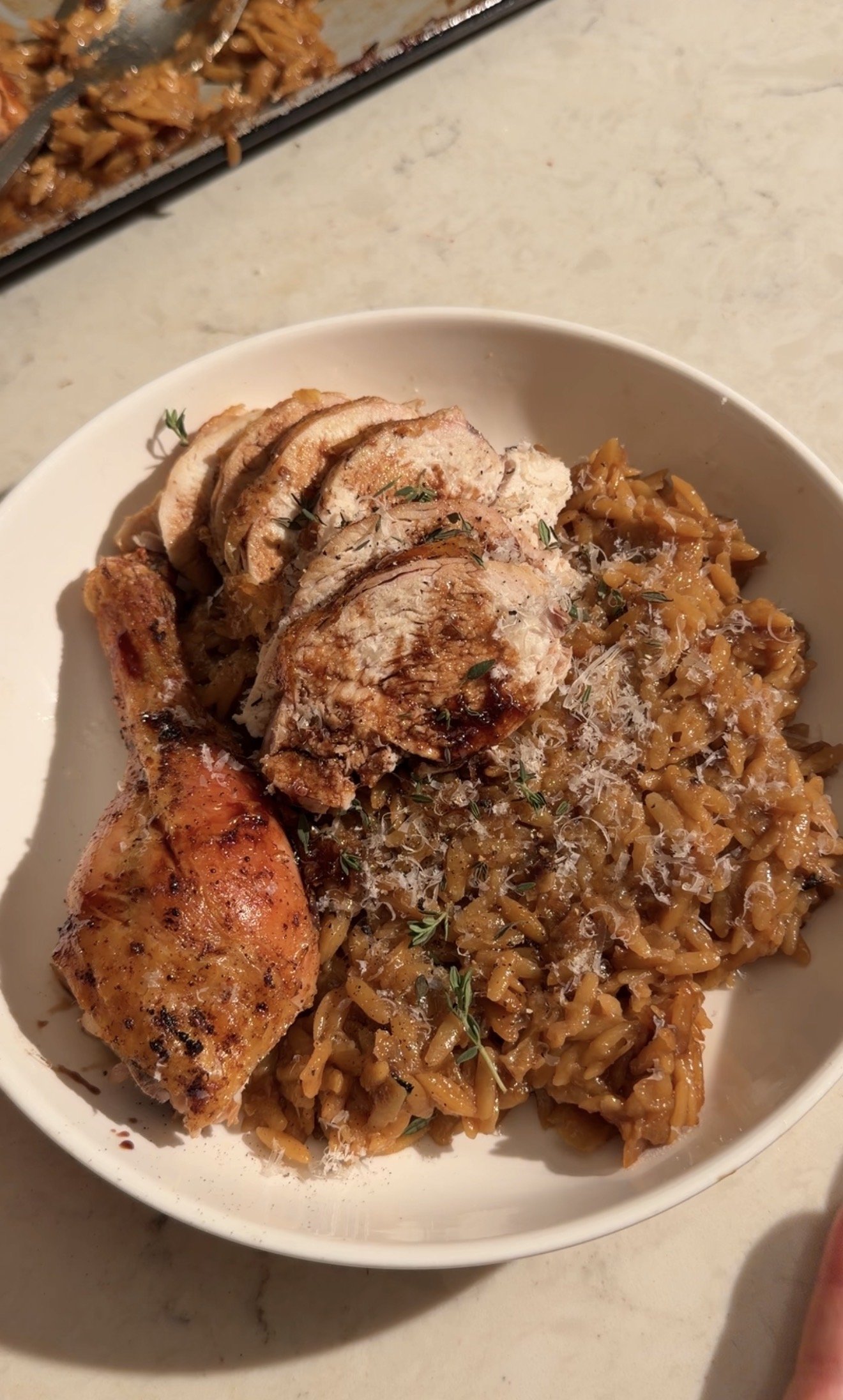
Stir freshly grated Gruyère into the hot orzo until melted, then carve the chicken and serve it right on top.
Tips for the best French onion chicken and orzo
- Trust your thermometer, not the clock. The chicken is done when the thickest part of the breast reaches 165°F and the thigh reaches about 175°F.
- Add water a little at a time. Every oven is different. A few dark edges add flavor, but avoid anything black.
- Keep the onions toward the center of the pan, since the edges brown fastest.
- Pat the chicken very dry. Dry skin gets crispy skin.
- Let the chicken rest 15–20 minutes before carving so the juices stay in the meat.
- Seal the foil tightly over the orzo. The trapped steam is what cooks it.
Frequently asked questions
What does it mean to spatchcock a chicken?
Spatchcocking means cutting out the backbone and pressing the chicken flat. It roasts faster and more evenly than a whole chicken and gives you more crispy skin. Most grocery store butchers will do it for you for free.
Can I make French onion orzo without wine?
Yes. Replace the ½ cup of white wine with ½ cup broth plus 1 teaspoon white wine vinegar or lemon juice.
Why are my onions burning?
The onions near the edges of the pan brown fastest. Keep them toward the center, check at 30 minutes, and add small splashes of water whenever the edges look too dark.
Do I need to cook the orzo first?
No. The dry orzo bakes right in the broth, cream, and onions on the sheet pan, covered with foil.
Can I use pre-shredded Gruyère?
You can, but freshly grated Gruyère from a block melts much smoother. Pre-shredded cheese has coatings that can make the orzo grainy.
What size chicken should I buy?
This recipe is written for a 4–4½ lb chicken. A chicken 5 lb or larger may need 70–90 minutes or more in the oven, so start checking the temperature around 45–50 minutes.
Sheet Pan French Onion Roast Chicken with Creamy Gruyère Orzo
Ingredients
For the Chicken & Onions
- 1 whole chicken 4–4½ lb
- 6 cups diced yellow onions about ½-inch pieces (5–6 onions)
- 4–5 tbsp avocado oil for the onions
- 1½ tsp Diamond Crystal kosher salt for the onions (see notes if using Morton)
- ⅓ cup water plus 2–4 cups on hand to add as needed during roasting
- 5–6 sprigs fresh thyme
- 1 tbsp avocado oil for the chicken
- Diamond Crystal kosher salt enough to generously season the chicken
- Freshly ground black pepper to taste
- Garlic-and-herb seasoning blend to taste (your favorite)
For the French Onion Orzo
- 16 oz dry orzo any brand
- ½ cup dry white wine such as Sauvignon Blanc or Pinot Grigio; see notes for a no-wine swap
- 4 cups beef broth one 32-oz carton
- 1 tsp Dijon mustard
- 1 tsp Worcestershire sauce
- ½ cup heavy cream
- 1–1½ cups freshly grated Gruyère cheese
- Fresh thyme for garnish
- Freshly ground black pepper to taste
- Additional water if needed
Equipment
- Half sheet pan (18 x 13 in, 1-inch rim)
- Oven-safe wire rack
- Kitchen shears
- Instant-read meat thermometer
- Aluminum foil
- Oven mitts
Directions
Before You Start
- Read the recipe all the way through once. Keep 2–4 cups of water in a measuring cup or pitcher next to the oven. You’ll add small splashes to the onions while the chicken roasts. You might not use it all, but you’ll have it ready if you need it.
- Grate your Gruyère from a block while the chicken roasts, so it’s ready at the end. An instant-read meat thermometer is the one tool you really need. It’s the only reliable way to know your chicken is done.
Roast the Chicken & Onions
- Preheat the oven to 425°F with a rack in the middle.
- Spatchcock the chicken: “Spatchcocking” means removing the backbone so the chicken lies flat, so it cooks faster and more evenly with more crispy skin. Place the chicken breast-side down on a large cutting board, tail end facing you. Using sharp kitchen shears, cut along both sides of the backbone from the tail toward the neck and remove it (keep it if you’d like to roast it for extra flavor). Flip the chicken breast-side up and press firmly on the center of the breast with the heels of your hands until it cracks and lies flat. Tuck the wing tips behind the breasts so they don’t burn. Pat the chicken very dry with paper towels. Shortcut: ask your grocery store butcher to spatchcock it for you.
- Season the chicken: Slide your fingers under the skin over the breasts and thighs to gently loosen it without tearing. Rub the chicken all over with 1 tablespoon avocado oil. Generously season with kosher salt, black pepper, and your garlic-and-herb blend under the skin directly on the meat, over the skin, and on the underside. If your blend contains salt, use a little less kosher salt. No advance brining is needed. Wash your hands, cutting board, and shears with hot, soapy water after handling raw chicken.
- Prepare the onions: Add the diced onions directly to the sheet pan. Drizzle with 4–5 tablespoons avocado oil, sprinkle with 1½ teaspoons kosher salt, and pour in ⅓ cup water. The water helps the onions soften before they brown, so they don’t scorch early. Toss to coat, then spread them in an even layer toward the center of the pan, leaving a little space around the edges. Scatter the thyme sprigs over the top.
- Set the wire rack over the onions and place the chicken skin-side up on the rack. Add the backbone to the rack too if you’d like. Roast at 425°F for about 45–60 minutes for a 4–4½ lb chicken.
- After 30 minutes, check the onions, especially around the edges. If they’re getting dark, add a splash of water (about ¼–½ cup), pouring it mostly around the edges to loosen the browned bits. Check every 10–15 minutes and repeat as needed. Add a little at a time so the water evaporates and the onions caramelize instead of boiling. A few dark edges are fine and add flavor; just avoid anything black. The drippings from the chicken will fall onto the onions and give them a rich, savory flavor.
- The chicken is done when an instant-read thermometer reads 165°F in the thickest part of the breast and about 175°F in the thickest part of the thigh, without touching the bone.
- Using oven mitts, remove the pan and carefully move the chicken to a cutting board to rest. Resting keeps the juices in the meat. Remove the rack, backbone (if using), and thyme stems. If there’s a lot of fat pooled in the pan, spoon some off, leaving about 2–3 tablespoons. Reduce the oven to 400°F.
Make the French Onion Orzo
- Deglaze the onions: “Deglazing” means adding liquid to a hot pan to lift the tasty browned bits stuck to the bottom. Pour the white wine over the onions and gently scrape up the browned bits with a silicone spatula, leaving behind any blackened, bitter pieces.
- Add the dry orzo to the onions. Pour in the beef broth (it can be straight from the carton), then add the Dijon, Worcestershire, and heavy cream. Stir gently until the orzo is spread evenly and mostly covered by liquid. The pan will be full.
- Cover the pan tightly with foil, crimping the edges so steam can’t escape. The steam is what cooks the orzo. Carefully return the pan to the oven, keeping it level, and bake at 400°F for 20–25 minutes, checking at 18–20 minutes. The orzo is done when it’s tender with a slight bite, most of the liquid is absorbed, and it looks creamy. If it’s still firm and the pan looks dry, stir in about ½ cup water, cover, and bake a few more minutes. Lift the foil carefully, as hot steam will escape.
- Remove the foil and stir in about 1 cup Gruyère, adding more to taste, until melted, rich, and creamy. No butter or extra baking needed.
Carve & Serve
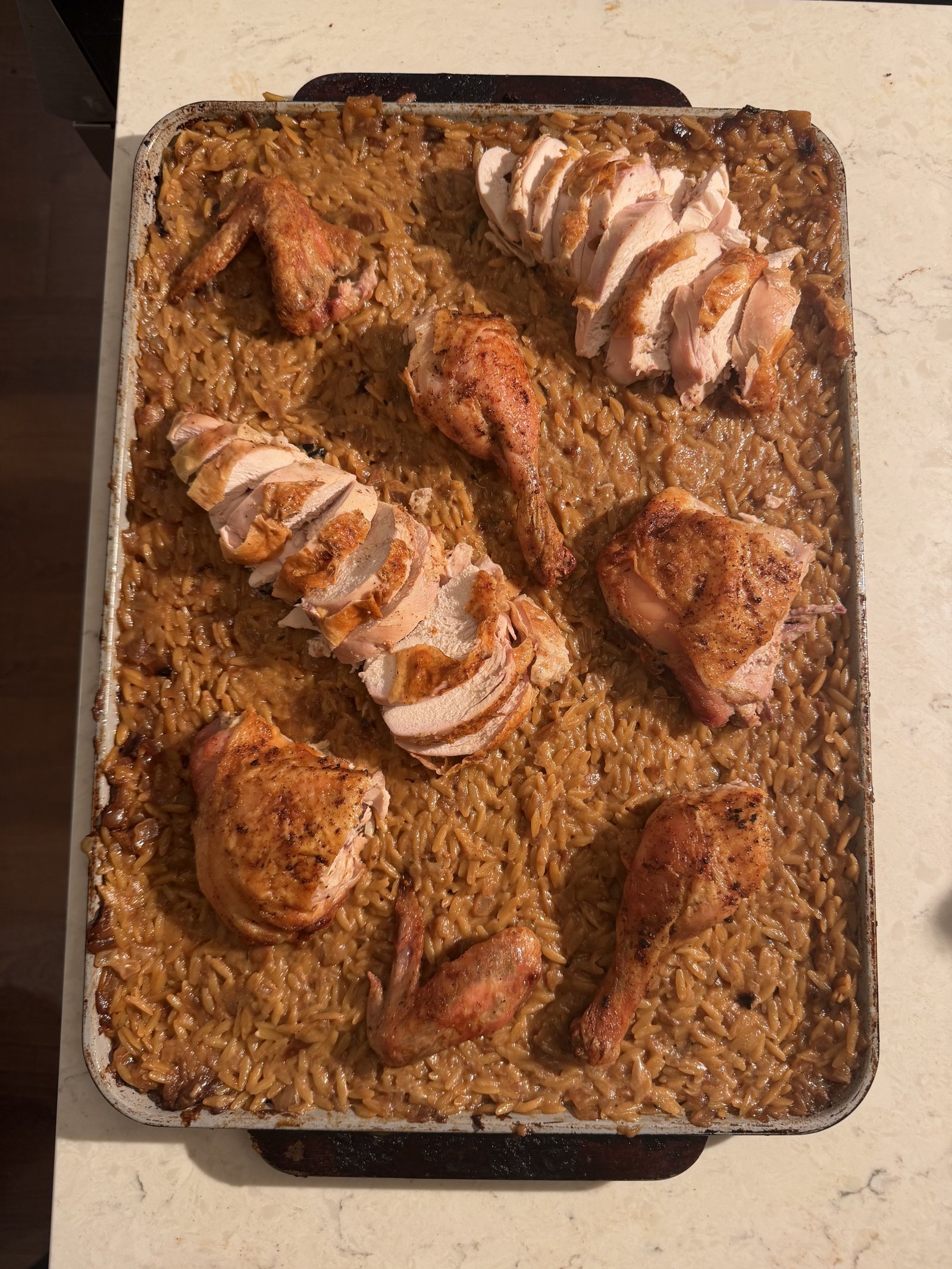
- While the orzo finishes, carve the chicken (it should rest at least 15–20 minutes). Cut off the legs and thighs at the joint, then the wings, then slice the breast meat. Arrange the chicken over or alongside the orzo, finish with fresh thyme and black pepper, and serve immediately.



Rate & Review
WHAT DID YOU THINK OF THIS RECIPE?